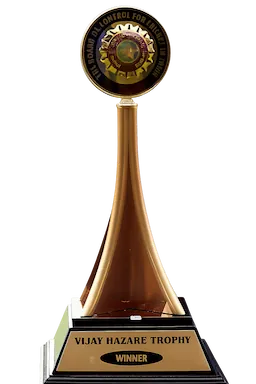
Vijay Hazare Trophy
The Vijay Hazare Trophy is a premier domestic one-day cricket tournament in India, featuring 38 teams from state units and cricket associations. Since its inception in 2002, the competition has consistently showcased top-tier talent, becoming a trusted stage for rising stars and seasoned performers. Known for its competitive Elite and Plate divisions, the tournament remains a key pillar of India’s domestic cricket calendar and a major reference point for fans tracking form, selection trends and team performances.
In the newly concluded 2025-2026 edition, Vidarbha created history by lifting their maiden Elite title after defeating Saurashtra by 38 runs in the final at the BCCI COE Ground 1, Bengaluru. Across the tournament, Vidarbha impressed with their disciplined approach, blending steady batting performances with smart, situation-aware bowling that kept them ahead in crucial Elite fixtures, ultimately recording five strong wins against just one defeat. In the Plate division, Bihar emerged victorious, underlining the growing depth and competitiveness across the tournament. With each season adding fresh narratives and standout performers, the Vijay Hazare Trophy continues to be one of India’s most closely followed one-day competitions.










Introduction
The Vijay Hazare Trophy is India’s leading domestic one‑day cricket tournament, a 50‑over competition that brings together 38 state and regional teams and consistently delivers high‑quality cricket for fans and bettors alike. Named after the legendary Vijay Hazare, the event blends emerging talent with seasoned domestic performers, creating a mix that keeps match odds, prediction angles and betting interest lively throughout the season. With its wide range of markets, from match winners to top batters and bowlers to dynamic in‑play options, the tournament remains one of the most engaging platforms for those who follow Indian cricket closely.
Beyond the cricketing stakes, the tournament reflects the cultural heartbeat of Indian sport. Local rivalries, packed venues and passionate home support give the competition a distinct flavour, while its role in spotlighting future national players adds to its significance. Over the years, the Vijay Hazare Trophy has evolved through different formats and structures, including the shift to Elite and Plate divisions, yet it has consistently maintained its reputation as a crucial stage for List A cricket in India.
Recent editions have shown how standout performers and title‑winning campaigns shape long‑term narratives and betting value. Karnataka’s fifth title in 2024‑2025, Haryana’s breakthrough win in 2023‑2024 and earlier landmark seasons have all contributed to the tournament’s identity as a fiercely competitive event where form, momentum and individual brilliance matter. Understanding these trends helps readers interpret team strength and player impact, making the Vijay Hazare Trophy not just a celebrated domestic competition but also a rich source of insight for those tracking performance patterns across Indian cricket.
You’ll also find a version of this article in Hindi (विजय हजारे ट्रॉफी हिंदी समीक्षा) integrated into the same narrative, where you can explore stats like Karnataka’s recent fifth title win and learn about top performers, insights that enhance your ability to bet on Vijay Hazare Trophy India with better context and make your Vijay Hazare Trophy betting tips India approach feel sharper and more informed at IndiaBetMaster.com.
Best Online Betting Sites in India - October 2026










































Current Season
The Vijay Hazare Trophy 2026-2027 arrives in a compact, high-intensity window from 14 December 2026 to 8 January 2027, and the confirmed schedule signals another season where India’s premier one-day domestic competition sits at the heart of the national white-ball conversation. The Elite division, which remains the main draw, will play its league matches across Rajkot, Bengaluru, Ahmedabad and Ranchi, before the knockouts shift to Vizag for a neutral-venue finish. The Plate division, running from 14 to 27 December 2026, will be held entirely in Indore, continuing the BCCI’s approach of giving Plate teams a stable, single-city environment. These details are fully verified from the 2026-2027 domestic calendar released in May 2026.
The structure remains consistent with last season: 38 teams split into Elite and Plate groups, with only one promotion and one relegation between divisions. This continuity reflects the BCCI’s confidence in the competitive balance achieved since the format change. The Elite league stage runs from 14 to 29 December 2026, followed by knockouts from 2 to 8 January 2027, while the Plate league and final conclude within a tighter 14-day window. The scheduling has been refined to avoid clashes with India’s senior ODI commitments, ensuring selectors can track performances closely, especially with the 2027 ODI World Cup cycle entering its decisive phase.
The venue spread adds a cultural and atmospheric layer that regular followers of domestic cricket will immediately recognise. Rajkot and Ahmedabad promise high-scoring afternoons, Bengaluru brings its familiar mix of swing-friendly mornings and lively crowds, and Ranchi offers a more balanced pitch profile that often shapes tactical decisions for teams. Vizag hosting the knockouts is a notable shift, giving the final stages a coastal venue known for strong turnouts and a festive cricket culture. Indore, hosting the Plate competition, has long been one of India’s most reliable domestic centres, with Holkar Stadium’s reputation for clean outfields and consistent pitches helping Plate teams showcase their best cricket.
Broadcast plans for the season follow the established pattern: Star Sports and Disney+ Hotstar continue to carry the men’s domestic tournaments nationwide, as confirmed through previous seasons’ coverage and the absence of any announced changes for 2026-2027. Industry reporting from recent domestic seasons indicates steady digital growth, especially for Elite matches that feature India-fringe players. This trend is expected to continue, particularly with the tournament placed in a relatively uncluttered December-January broadcast window.
The BCCI’s domestic match-fee structure remains one of the strongest in world cricket. The last officially published numbers for senior men’s List A cricket place match fees at INR 36,000 per game for senior players, with higher slabs for those with significant international experience.
Ahmedabad and Rajkot, in particular, have shown excellent domestic turnouts in recent years, and Bengaluru’s weekday crowds have historically been among the most engaged in the country. Past media reports suggest that Elite matches in major centres often draw several thousand spectators per game, especially when India-fringe players are involved. With the tournament positioned just before India’s 2027 World Cup build-up, the competition is expected to attract strong attention, especially around teams with strong top-order depth and reliable seam attacks, which often shape the tactical battles in December conditions.
Overall, the 2026-2027 Vijay Hazare Trophy shapes up as a crisp, competitive and culturally rich edition, with a clear Elite-first spotlight and a Plate competition that continues to offer meaningful upward mobility. The confirmed dates, venues and structure point to a tournament designed for both cricketing clarity and fan engagement, and the blend of familiar centres with a Vizag finale adds a fresh flavour to the season. For Indian fans tracking form, momentum and squad balance, this edition promises a month of high-quality domestic one-day cricket with genuine selection stakes and plenty of memorable cricketing moments.
Ongoing October 2026 Events
 |
ICC World Test Championship (WTC) Test | June 17, 2025 – June 13, 2027 | LIVE |
|
ICC Women's Championship ODI | February 20, 2026 – April 15, 2029 | LIVE |
 |
Minor League Cricket (MiLC) T20 | September 17, 2026 – October 25, 2026 | LIVE |
|
Cricket at the Asian Games T20I | September 17, 2026 – October 3, 2026 | |
  |
South Africa vs Australia Tour | September 24, 2026 – October 31, 2026 | LIVE |
 |
Col CK Nayudu Winners vs ROI FC | October 1–4, 2026 | |
|
Irani Cup FC | October 1–5, 2026 | |
 |
National Cricket League (NCL) FC | October 3, 2026 – November 17, 2026 | LIVE |
|
Vinoo Mankad Trophy List A | October 8–27, 2026 | LIVE |
  |
Sri Lanka vs Pakistan Tour | October 9, 2026 – November 21, 2026 | LIVE |
|
Women's U19 T20 Trophy T20 | October 9–26, 2026 | LIVE |
|
Ranji Trophy FC | October 11, 2026 – March 3, 2027 | LIVE |
|
Col CK Nayudu Trophy Multi-Day | October 12, 2026 – March 1, 2027 | LIVE |
 |
India vs New Zealand Tour | October 22, 2026 – December 1, 2026 | LIVE |
 |
Nepal Premier League (NPL) T20 | October 26, 2026 – November 21, 2026 | |
|
Senior Women's T20 Trophy T20 | October 26, 2026 – November 20, 2026 | |
 |
Bangladesh vs West Indies Test | October 28, 2026 – November 9, 2026 | |
|
Women's Big Bash League (WBBL) T20 | October 29, 2026 – December 5, 2026 | |
|
Women's U19 T20 Challenger Trophy T20 | October 30, 2026 – November 5, 2026 |
Ongoing October 2026 Events
|
ICC World Test Championship (WTC) Test | June 17, 2025 – June 13, 2027 | LIVE |
|
ICC Women's Championship ODI | February 20, 2026 – April 15, 2029 | LIVE |
|
Minor League Cricket (MiLC) T20 | September 17, 2026 – October 25, 2026 | LIVE |
|
Cricket at the Asian Games T20I | September 17, 2026 – October 3, 2026 | |
|
South Africa vs Australia Tour | September 24, 2026 – October 31, 2026 | LIVE |
|
Col CK Nayudu Winners vs ROI FC | October 1–4, 2026 | |
|
Irani Cup FC | October 1–5, 2026 | |
|
National Cricket League (NCL) FC | October 3, 2026 – November 17, 2026 | LIVE |
|
Vinoo Mankad Trophy List A | October 8–27, 2026 | LIVE |
|
Sri Lanka vs Pakistan Tour | October 9, 2026 – November 21, 2026 | LIVE |
|
Women's U19 T20 Trophy T20 | October 9–26, 2026 | LIVE |
|
Ranji Trophy FC | October 11, 2026 – March 3, 2027 | LIVE |
|
Col CK Nayudu Trophy Multi-Day | October 12, 2026 – March 1, 2027 | LIVE |
|
India vs New Zealand Tour | October 22, 2026 – December 1, 2026 | LIVE |
|
Nepal Premier League (NPL) T20 | October 26, 2026 – November 21, 2026 | |
|
Senior Women's T20 Trophy T20 | October 26, 2026 – November 20, 2026 | |
|
Bangladesh vs West Indies Test | October 28, 2026 – November 9, 2026 | |
|
Women's Big Bash League (WBBL) T20 | October 29, 2026 – December 5, 2026 | |
|
Women's U19 T20 Challenger Trophy T20 | October 30, 2026 – November 5, 2026 |


Previous Seasons
Past Vijay Hazare Trophy Editions
- 2025-2026 Season
The 2025-2026 edition of the Vijay Hazare Trophy ran from 24 December 2025 to 18 January 2026 and delivered a strong, competitive season across both Elite and Plate levels. Vidarbha claimed the Elite title for the first time, defeating Saurashtra by 38 runs in the final at the BCCI Centre of Excellence Ground in Bengaluru. Vidarbha posted 317 for 8, led by Atharva Taide’s superb 128, before bowling out Saurashtra for 279 to seal the championship. The tournament followed the established Elite and Plate structure, with group stages feeding into knockouts, and continued to offer a clear pathway for teams across divisions. Bihar won the Plate title earlier in the season, earning promotion to the Elite tier for 2026-2027, a result that added meaningful movement within the competition.
This edition stood out for its consistent batting performances and several high-impact individual campaigns that shaped the season’s major storylines. Aman Mokhade finished as Player of the Series with 814 runs, underlining Vidarbha’s strong campaign in the Elite division. The season maintained strong competitive balance, with tight group races and a knockout phase that featured in-form sides peaking at the right time. With its mix of emerging talent, experienced domestic performers and high-scoring venues, the 2025-2026 Vijay Hazare Trophy reinforced its status as India’s premier List A competition and provided a valuable view of team momentum ahead of the next cycle.
- 2024-2025 Season
It was exciting to watch the Vijay Hazare Trophy season in 2024-2025. It showed how tough Indian regional cricket is. Karnataka won their fifth title by beating Vidarbha by 36 runs in a closely fought final. They performed strongly throughout the match, with a powerful batting display helping them secure the championship. Karnataka scored 348/6 in the final, with Smaran Ravichandran and Krishnan Shrijith making important contributions. Vidarbha fought hard in the chase, with Dhruv Shorey’s hundred leading the response, but they were bowled out for 312.
Several outstanding individual efforts made the event memorable. Karun Nair of Vidarbha was named Player of the Series after scoring 779 runs, highlighting his consistency throughout the tournament. On the bowling front, Arshdeep Singh of Punjab took the most wickets with 20, showing his impact with the ball. These performances reflected the depth of talent on display during the Vijay Hazare Trophy and highlighted the importance of individual contributions in shaping team success across the competition.
The 2024-2025 tournament had 38 teams split into five groups, called A-E. The group stage was set up like a round-robin, with the five group winners and the best runner-up going straight to the quarterfinals. The remaining four runners-up competed in preliminary quarterfinals to complete the final eight. This setup made the event highly competitive, with teams fighting for stronger positions throughout the group stage. The playoff system ensured that the best-performing sides progressed to the later stages of the tournament.
The impact of the previous season was felt across Indian domestic cricket, with several players using the tournament as a platform to make an impression. Haryana’s run to the semi-finals before losing to eventual champions Karnataka was one of the notable stories of the competition. Fans followed the event closely because of its competitive matches, emerging talent and strong performances from domestic teams. The tournament continued to highlight the BCCI’s focus on developing and strengthening India’s domestic cricket structure.
- Earlier Seasons
The Vijay Hazare Trophy, an annual List A cricket competition in India, played its 31st edition in 2023-2024. It took place from November 12, 2023, until December 16, 2023. There were 38 teams in all, split into five groups for the tournament. Six cities in the nation hosted the matches: Bengaluru, Delhi, Kolkata, Mumbai, Ranchi, and Ahmedabad. The knockout matches were held in Rajkot. Saurashtra entered the tournament as defending champions. Haryana won their first national title in the final, defeating Rajasthan by 30 runs.
After the group stage and knockout rounds, four teams qualified for the semi-finals: Haryana, Tamil Nadu, Karnataka, and Rajasthan. The first semi-final took place on December 13 at Saurashtra Cricket Association Stadium, Rajkot, between Haryana and Tamil Nadu. Haryana won by 63 runs and advanced to the final of the Vijay Hazare Trophy. The second semi-final was played on December 14 at the same venue between Karnataka and Rajasthan, with Rajasthan winning by 6 wickets to secure their place in the final.
In the final of the Vijay Hazare Trophy 2023-2024, held on December 16, 2023, at the Saurashtra Cricket Association Stadium in Rajkot, Haryana defeated Rajasthan by 30 runs. Haryana, opting to bat first, set a target of 288 runs with Ankit Kumar top-scoring at 88 off 91 balls. Rajasthan's Aniket Choudhary was the standout bowler, taking 4/49. In response, Rajasthan managed 257 runs in 48 overs, with Abhijeet Tomar scoring a resilient 106 off 129 balls. Sumit Kumar's 3/34 helped restrict Rajasthan's chase, earning him the Man of the Match award and securing Haryana's victory.
The competition, which bears the name Vijay Hazare in honor of the legendary Indian cricketer, was established as a national tournament in the 2002-2003 season. Before that, the competition was played at a zonal level during the 1993-1994 and 2001-2002 seasons. Tamil Nadu has won the trophy 5 times, making them one of the most successful teams in the competition's history. The best teams from each zone competed in a final round-robin stage during the 2002-2003 and 2003-2004 seasons. A playoff structure featuring semi-finals and a final has been used since the 2004-2005 event, although the format has changed over the years.
The winning team of the first national season was Tamil Nadu, with Punjab finishing as runners-up. Mumbai won the 2003-2004 season. The 2004-2005 season had two winners. Railways won the following season in 2005-2006. The Vijay Hazare Trophy has been played regularly since 2002, with the winners of the following seasons being Mumbai, Saurashtra, Tamil Nadu, Tamil Nadu, Jharkhand, Bengal, Delhi, Karnataka, Karnataka, Gujarat, Tamil Nadu, Karnataka, Mumbai, Karnataka, Mumbai, Himachal Pradesh, Saurashtra, and Haryana. These teams represent the winners of the first 22 national seasons of the Vijay Hazare Trophy.
Tamil Nadu has won the Vijay Hazare Trophy a record five times, making them the most successful team in the tournament's history. Karnataka and Mumbai have also enjoyed strong campaigns, with multiple titles each. Saurashtra have also established themselves as a major force in domestic cricket, winning the trophy twice in recent seasons, including their first title in the 2008-2009 season.
This tournament has helped develop many talented players over the years, including Narayan Jagadeesan. In the 2022-2023 Vijay Hazare Trophy, Jagadeesan became the first player to score five consecutive List A centuries. His 277 against Arunachal Pradesh also broke the record for the highest individual score by a male batter in List A cricket at the time, surpassing Ali Brown's previous mark of 268.
| Season | Champion | Runner-up | Final Result | Event / Final Location |
|---|---|---|---|---|
| 2025-2026 | Vidarbha | Saurashtra | Vidarbha Won by 38 Runs | BCCI Centre of Excellence Ground 1, Bengaluru |
| 2024-2025 | Karnataka | Vidarbha | Karnataka Won by 36 Runs | Kotambi Stadium, Vadodara |
| 2023-2024 | Haryana | Rajasthan | Haryana Won by 30 Runs | Niranjan Shah Stadium, Rajkot |
| 2022-2023 | Saurashtra | Maharashtra | Saurashtra Won by 5 Wickets | Narendra Modi Stadium, Ahmedabad |
| 2021-2022 | Himachal Pradesh | Tamil Nadu | Himachal Pradesh Won by 11 Runs (VJD Method) | Sawai Mansingh Stadium, Jaipur |
| 2020-2021 | Mumbai | Uttar Pradesh | Mumbai Won by 6 Wickets | Arun Jaitley Cricket Stadium, Delhi |
| 2019-2020 | Karnataka | Tamil Nadu | Karnataka Won by 60 Runs (VJD Method) | M. Chinnaswamy Stadium, Bengaluru |
| 2018-2019 | Mumbai | Delhi | Mumbai Won by 4 Wickets | M. Chinnaswamy Stadium, Bengaluru |
| 2017-2018 | Karnataka | Saurashtra | Karnataka Won by 41 Runs | Arun Jaitley Stadium, New Delhi |
| 2016-2017 | Tamil Nadu | Bengal | Tamil Nadu won by 37 Runs | Arun Jaitley Cricket Stadium, Delhi |
| 2015-2016 | Gujarat | Delhi | Gujarat Won by 139 Runs | M. Chinnaswamy Stadium, Bengaluru |
| 2014-2015 | Karnataka | Punjab | Karnataka won by 156 runs | Sardar Patel Stadium, Ahmedabad |
| 2013-2014 | Karnataka | Railways | Karnataka won by 4 wickets | Eden Gardens, Kolkata |
| 2012-2013 | Delhi | Assam | Delhi won by 75 runs | Dr. Y. S. Rajasekhara Reddy International Cricket Stadium, Vishakhapatnam |
| 2011-2012 | Bengal | Mumbai | Bengal won by 6 wickets | Arun Jaitley Cricket Stadium, Delhi |
| 2010-2011 | Jharkhand | Gujarat | Jharkhand won by 159 runs | Holkar Cricket Stadium, Indore |
| 2009-2010 | Tamil Nadu | Bengal | Tamil Nadu won by 29 runs | Sardar Patel Stadium, Ahmedabad |
| 2008-2009 | Tamil Nadu | Bengal | Tamil Nadu won by 66 runs | Maharaja Bir Bikram College Stadium, Agartala |
| 2007-2008 | Saurashtra | Bengal | Saurashtra won by 6 wickets | Dr. Y. S. Rajasekhara Reddy International Cricket Stadium, Vishakhapatnam |
| 2006-2007 | Mumbai | Rajasthan | Mumbai won by 72 runs | Sawai Mansingh Stadium, Jaipur |
| 2005-2006 | Railways | Uttar Pradesh | Railways won by 20 runs | Wankhede Stadium, Mumbai |
| 2004-2005 | Tamil Nadu & Uttar Pradesh (Shared) | -- | Match tied; Title was shared between the two teams | Wankhede Stadium, Mumbai |
| 2003-2004 | Mumbai | Bengal | Mumbai won the super-league with 14 points | No Final (Round-robin & Super League) |
| 2002-2003 | Tamil Nadu | Punjab | Tamil Nadu won the league | No Final (Round-robin & Super League) |
* 1993-2002 Seasons were played as Zonal tournaments with 5 different winners
History and Structure
India's national cricket team has benefited from the growth of domestic cricket competitions. Domestic tournaments have given new players a platform to develop their skills, adapt to the team's culture, and attract the attention of selectors. These competitions have also helped players gain experience across different playing conditions, surfaces, and match situations that can prepare them for international cricket. Vijay Hazare Trophy plays an important role in India's domestic cricket structure.
Since the Vijay Hazare Trophy's founding in the 2002-2003 season, it has become one of India's leading domestic one-day competitions. Over the years, the tournament format has evolved, with teams being organized into groups and progressing through knockout stages to compete for the title.
The competition's format changed in the 2017-2018 season, when the BCCI introduced a new structure featuring 38 teams divided into Elite and Plate groups. The tournament continued to provide a platform for teams from across India to compete in a national-level one-day competition, with the top-performing sides progressing through the stages to decide the winner. With a larger field and more matches, the tournament has grown into one of the most important parts of India's domestic cricket calendar.
Before the current structure was introduced, the competition followed a different format based around zonal groups. Teams competed within their respective groups, with the tournament structure gradually developing over time to create a more competitive national championship.



Final Thoughts
When Indian cricketers choose to participate in domestic leagues, they get access to a wide range of advantages. To begin with, players can develop their talents and become ready for international cricket by participating in competitive games where they gain valuable experience. The Board of Control for Cricket in India (BCCI), which sponsors numerous domestic competitions, also provides financial opportunities for players who compete in them.
The Indian National Cricket Team's domestic structure has also enabled the squad to maintain a coordinated and efficient selection process. This has made it possible for selectors to identify the top players from across the nation and ensure they are well-prepared for a variety of situations. The domestic framework also offers a pathway for senior players to return to the squad and for emerging players to progress to the international level.
The performance of the India National Cricket Team is significantly influenced by domestic cricket. It offers a platform for athletes to refine their abilities and gain valuable experience while also supporting an effective selection process. Players can earn match payments and build recognition in the cricketing community by participating in the domestic system. In the end, India's strong domestic structure has contributed to the success of the national cricket team. The Vijay Hazare Trophy also plays an important role in identifying and developing talented players for India's future cricket teams.
Did You Know
