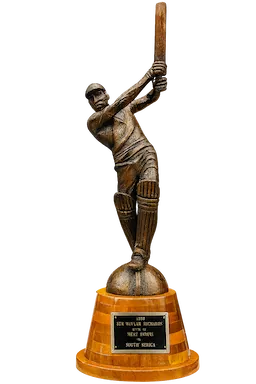
Sir Vivian Richards Trophy
The Sir Vivian Richards Trophy shows how popular Test cricket remains today. It represents the strong but respectful rivalry between South Africa and the West Indies, two of the game’s most passionate cricketing nations. Named after the legendary “Master Blaster” Sir Vivian Richards, the trophy represents not only cricketing excellence but also the sport’s long history and cultural importance in both regions. Fans look forward to each South Africa vs West Indies Test series for the competitive cricket, memorable moments and compelling storylines.
The 2022-2023 Sir Vivian Richards Trophy Test series was held in South Africa, where the hosts secured a 2-0 victory across two matches, sealing the trophy with a commanding win in the Johannesburg Test. South Africa’s result extended their strong modern record against the West Indies in this format, reaffirming the long-standing structure of the Sir Vivian Richards Trophy, which has been contested since 1998-1999.




Cricket West Indies (CWI)






Introduction
Sir Vivian Richards Trophy carries a distinct place in international cricket, shaped by the long and storied Test rivalry between South Africa and the West Indies. Named after one of the game’s most influential figures, it reflects both the competitive fire of the two teams and the cultural weight of Caribbean cricket. The contest has often mirrored broader shifts in the sport, from changes in touring structures to evolving broadcast priorities, with each cycle adding new layers to its legacy. Even without focusing on specific editions, the trophy stands as a marker of how cricketing identities have been built, challenged and reimagined across eras.
Its roots lie in the period when bilateral Test cricket was undergoing structural refinement, and the West Indies’ long-standing rivalry with South Africa made their series important fixtures on the international calendar. The trophy was introduced in 2001 as a tribute to Sir Vivian Richards and to recognize his exceptional contribution to world cricket. As the game modernized, the trophy became a symbol of continuity, preserving the traditional Test format while adapting to new scheduling realities and commercial frameworks. The competitive balance between the sides has fluctuated over the years, yet the trophy has consistently produced narratives that resonate with fans, analysts and former players alike. For readers on IndiaBetMaster.com, this context helps frame the trophy not just as a sporting contest but as a cultural exchange shaped by history, pride and cricketing craft.
Beyond the on-field battles, the Sir Vivian Richards Trophy has also reflected the broader evolution of cricket’s presentation. Shifts in broadcast technology, audience expectations and global reach have influenced how the series is consumed and remembered. The trophy’s identity is tied to the charisma of its namesake, whose impact on Caribbean cricket continues to inspire new generations. This blend of heritage and modernity makes the trophy an engaging subject for anyone exploring the deeper layers of Test cricket.
Readers who prefer to explore the subject in another language can also dive into the article’s Hindi version (सर विवियन रिचर्ड्स ट्रॉफी की हिंदी समीक्षा), which offers additional context and cultural angles that enrich the understanding of the trophy’s significance.
Best Online Betting Sites in India - October 2026










































Current Season
Currently, no official schedule has been confirmed for the next edition of the Sir Vivian Richards Trophy, the historic Test series contested between South Africa and West Indies. However, both teams remain active participants in the 2025-2027 ICC World Test Championship (WTC), which shapes the structure and significance of future bilateral Test encounters, including this prestigious trophy series. Any future series under this banner is expected to be influenced by the WTC schedule, recent performances, and player availability at the time of scheduling.
South Africa have displayed remarkable consistency in recent Test cricket, including strong performances during the previous WTC cycle and a disciplined pace attack that remains a major strength in international cricket. This form would make them a formidable opponent in any upcoming Sir Vivian Richards Trophy contest. Meanwhile, the West Indies have continued to develop their Test side, particularly through performances in Caribbean conditions. Their bowling group has shown the ability to challenge stronger opponents, adding an element of unpredictability to future encounters.
For the Sir Vivian Richards Trophy, attention will instead turn to practical factors such as team announcements, venue details, pitch conditions, and injury news once the series is officially scheduled. Following developments from both camps will provide useful context, as squad depth, home conditions, and the wider WTC calendar can all shape the outlook for a Test series. Until the next edition is confirmed, keeping track of Test cricket form and squad selections will offer the clearest picture of what to expect when the Sir Vivian Richards Trophy returns to the schedule.
Ongoing October 2026 Events
 |
ICC World Test Championship (WTC) Test | June 17, 2025 – June 13, 2027 | LIVE |
|
ICC Women's Championship ODI | February 20, 2026 – April 15, 2029 | LIVE |
 |
Minor League Cricket (MiLC) T20 | September 17, 2026 – October 25, 2026 | LIVE |
|
Cricket at the Asian Games T20I | September 17, 2026 – October 3, 2026 | |
  |
South Africa vs Australia Tour | September 24, 2026 – October 31, 2026 | LIVE |
 |
Col CK Nayudu Winners vs ROI FC | October 1–4, 2026 | |
|
Irani Cup FC | October 1–5, 2026 | |
 |
National Cricket League (NCL) FC | October 3, 2026 – November 17, 2026 | LIVE |
|
Vinoo Mankad Trophy List A | October 8–27, 2026 | LIVE |
  |
Sri Lanka vs Pakistan Tour | October 9, 2026 – November 21, 2026 | LIVE |
|
Women's U19 T20 Trophy T20 | October 9–26, 2026 | LIVE |
|
Ranji Trophy FC | October 11, 2026 – March 3, 2027 | LIVE |
|
Col CK Nayudu Trophy Multi-Day | October 12, 2026 – March 1, 2027 | LIVE |
 |
India vs New Zealand Tour | October 22, 2026 – December 1, 2026 | LIVE |
 |
Nepal Premier League (NPL) T20 | October 26, 2026 – November 21, 2026 | |
|
Senior Women's T20 Trophy T20 | October 26, 2026 – November 20, 2026 | |
 |
Bangladesh vs West Indies Test | October 28, 2026 – November 9, 2026 | |
|
Women's Big Bash League (WBBL) T20 | October 29, 2026 – December 5, 2026 | |
|
Women's U19 T20 Challenger Trophy T20 | October 30, 2026 – November 5, 2026 |
Ongoing October 2026 Events
|
ICC World Test Championship (WTC) Test | June 17, 2025 – June 13, 2027 | LIVE |
|
ICC Women's Championship ODI | February 20, 2026 – April 15, 2029 | LIVE |
|
Minor League Cricket (MiLC) T20 | September 17, 2026 – October 25, 2026 | LIVE |
|
Cricket at the Asian Games T20I | September 17, 2026 – October 3, 2026 | |
|
South Africa vs Australia Tour | September 24, 2026 – October 31, 2026 | LIVE |
|
Col CK Nayudu Winners vs ROI FC | October 1–4, 2026 | |
|
Irani Cup FC | October 1–5, 2026 | |
|
National Cricket League (NCL) FC | October 3, 2026 – November 17, 2026 | LIVE |
|
Vinoo Mankad Trophy List A | October 8–27, 2026 | LIVE |
|
Sri Lanka vs Pakistan Tour | October 9, 2026 – November 21, 2026 | LIVE |
|
Women's U19 T20 Trophy T20 | October 9–26, 2026 | LIVE |
|
Ranji Trophy FC | October 11, 2026 – March 3, 2027 | LIVE |
|
Col CK Nayudu Trophy Multi-Day | October 12, 2026 – March 1, 2027 | LIVE |
|
India vs New Zealand Tour | October 22, 2026 – December 1, 2026 | LIVE |
|
Nepal Premier League (NPL) T20 | October 26, 2026 – November 21, 2026 | |
|
Senior Women's T20 Trophy T20 | October 26, 2026 – November 20, 2026 | |
|
Bangladesh vs West Indies Test | October 28, 2026 – November 9, 2026 | |
|
Women's Big Bash League (WBBL) T20 | October 29, 2026 – December 5, 2026 | |
|
Women's U19 T20 Challenger Trophy T20 | October 30, 2026 – November 5, 2026 |



Previous Seasons
Sir Vivian Richards Trophy has been a defining part of the South Africa–West Indies Test rivalry since the late 1990s, carrying forward the legacy of one of cricket’s most iconic figures. Across its many editions, the contest has showcased shifts in team strength, touring patterns and long-term cricketing priorities, while still preserving the traditional appeal of multi-Test series. The trophy’s history reflects memorable spells, decisive sessions and changing competitive cycles, with South Africa generally holding the upper hand but the West Indies producing landmark performances that continue to shape the narrative of this storied encounter.
Past Sir Vivian Richards Trophy Editions
- 2022-2023 Series (South Africa)
The 2022-2023 cycle was played in South Africa across two Tests from late February to mid March, forming part of the international calendar and the World Test Championship structure. South Africa secured the trophy with a 2-0 series result, built on strong top-order runs and a relentless pace attack that controlled key phases in both matches. The second Test in Johannesburg ended with South Africa winning by a large margin, underlining their home dominance and extending an unbeaten run in Sir Vivian Richards Trophy contests.
Beyond the scoreline, the 2022-2023 edition highlighted the contrasting trajectories of the two sides, with South Africa consolidating a new core and the West Indies using the tour to expose emerging players to demanding conditions. The series drew solid broadcast interest and media coverage, becoming a reference point for long-term cricket analysis, series previews and the wider story of this rivalry.
- 2021 Series (West Indies)
The 2021 edition took place in the Caribbean, where South Africa toured for a two-Test series in June. South Africa claimed the trophy with a 2-0 result, finishing clearly on top through disciplined fast bowling and compact batting performances. The matches were played at key West Indian venues, and while the series was short, it retained the intensity that has long characterised contests between these two teams.
The final Test saw South Africa close out the series with a comfortable victory, reinforcing their ability to adapt to away conditions and maintain control over the trophy. This tour also reflected wider scheduling and financial realities of modern Test cricket, fitting into a busy calendar while still offering meaningful context for fans tracking long-term form, team strategies and developments in South Africa–West Indies cricket.
- 2014-2015 Series (South Africa)
The 2014-2015 edition was staged in South Africa as part of West Indies’ tour during the southern summer. The series comprised three Tests, with South Africa winning 2-0 and the final match in Cape Town ending in their favour after sustained pressure from the bowling unit. The contest added another chapter to South Africa’s strong home record, while the West Indies continued a rebuilding phase against high-quality opposition.
This edition sat within a period of evolving broadcast formats and growing digital coverage, helping the trophy gain visibility among global cricket followers. It also provided useful benchmarks for analysts and fans comparing team cycles, series trends and long-term performance patterns in Sir Vivian Richards Trophy history.
- Earlier Seasons
Earlier cycles of the Sir Vivian Richards Trophy have produced some of the most memorable moments in South Africa–West Indies Test history. The trophy’s early years were shaped by South Africa’s rise as a dominant Test side and the West Indies’ efforts to transition from their golden era into a new generation. Several editions featured standout spells from fast bowlers, breakthrough innings from young batters and tactical battles that defined the cricketing identity of both teams. South Africa has historically held the majority of series wins, yet the West Indies have delivered performances that remain central to the trophy’s legacy.
Across the 1998-1999 to 2010 period, the contest evolved alongside changes in global cricket structures, including shifts in touring cycles, commercial priorities and broadcast innovations. The trophy became a regular feature in bilateral scheduling, often producing high-intensity cricket despite fluctuations in competitive balance. These earlier editions also contributed significantly to the cultural weight of the rivalry, with followers tracking long-term records, form guides and key developments as part of a wider interest in Test cricket history.
| Season | Champion | Runner-up | Final Result | Event / Final Location |
|---|---|---|---|---|
| Sir Vivian Richards Trophy | ||||
| 2024 | South Africa | West Indies | South Africa won 1-0 (2 Tests) | West Indies |
| 2022-2023 | South Africa | West Indies | South Africa won 2-0 (2 Tests) | South Africa |
| 2021 | South Africa | West Indies | South Africa won 2-0 (2 Tests) | West Indies |
| 2014-2015 | South Africa | West Indies | South Africa won 2-0 (3 Tests) | South Africa |
| 2010 | South Africa | West Indies | South Africa won 2-0 (3 Tests) | West Indies |
| 2007-2008 | South Africa | West Indies | South Africa won 2-1 (3 Tests) | South Africa |
| 2004-2005 | South Africa | West Indies | South Africa won 2-0 (4 Tests) | West Indies |
| 2003-2004 | South Africa | West Indies | South Africa won 3-0 (4 Tests) | South Africa |
| 2000-2001 | South Africa | West Indies | South Africa won 2-1 (5 Tests) | West Indies |
| 1998-1999 | South Africa | West Indies | South Africa won 5-0 (5 Tests) | South Africa |
| Test Series | ||||
| 1992 | West Indies | South Africa | West Indies won 1-0 (1 Test) | West Indies |
* Refers only to Test cricket encounters.
History and Structure
Origins and Early Development
Sir Vivian Richards Trophy was formally introduced in the 1998-1999 Test series between South Africa and the West Indies, marking the first time their bilateral contest carried an official title. Although the teams had already met in the historic 1991-1992 series after South Africa’s return to international cricket, the naming of the trophy in honour of Sir Vivian Richards added cultural significance and recognized the Caribbean’s deep cricketing heritage. The inaugural 1998-1999 edition was a five-Test tour organized by the United Cricket Board of South Africa and the West Indies Cricket Board, and its 5-0 result for South Africa set an early competitive tone that shaped the rivalry for years.
Structure, Scheduling and Influences
The trophy has always been contested within the framework of bilateral Test tours, with hosting duties alternating between South Africa and the West Indies. Series lengths have varied across eras, influenced by global scheduling pressures, broadcast contracts and the shift from long-format tours to compact multi-format itineraries. In the late 1990s and early 2000s, five-Test series were still feasible due to wider calendar flexibility and the commercial value of extended tours. By the 2014-2015 and 2021 cycles, the structure had evolved into two or three-Test formats, reflecting modern ICC scheduling, increased T20 and ODI commitments, and the introduction of the World Test Championship, which added competitive context and influenced squad rotation and tour planning.
Technological and broadcasting advancements have played a major role in shaping the trophy’s visibility. The move from analogue television to HD and later digital streaming expanded global reach, making South Africa–West Indies contests accessible to wider audiences and enabling real-time analysis, predictive discussions and deeper engagement. Political and financial factors also influenced the rivalry’s rhythm. South Africa’s reintegration into world cricket in the early 1990s opened the door for regular bilateral contests, while the West Indies’ structural transitions and regional cricket politics affected squad stability and long-term competitiveness. Fashion and culture even found subtle influence, with the trophy’s early years coinciding with the rise of iconic Proteas and Caribbean cricketing identities that shaped how fans perceived the rivalry.
Milestones and Long-Term Significance
Across 1998-1999 to 2022-2023, the trophy has produced defining milestones. South Africa’s dominance through the 2000s was driven by elite fast bowlers and consistent batting cores, while the West Indies delivered standout individual performances that remain central to the trophy’s legacy. Jacques Kallis’ aggregate of more than 2300 runs and Shaun Pollock’s 70 wickets in trophy contests stand out as unmatched markers of sustained excellence. The rivalry also adapted to global cricket trends, including the rise of analytics, enhanced player fitness regimes and the commercialisation of international tours, all of which influenced how teams approached preparation and strategy.



Final Thoughts
Sir Vivian Richards Trophy has grown into one of the most meaningful markers of the South Africa-West Indies Test relationship, shaped by decades of evolving cricket culture and the changing priorities of international scheduling. From its establishment in 1998-1999 to its modern role within the ICC’s Test structure, the contest has reflected how teams adapt across eras, whether through shifts in selection philosophy, the rise of new fast-bowling generations or the influence of broader cricketing reforms. Its history shows how two cricketing cultures with distinct identities continue to find common ground through long-format competition.
Across the years, the trophy has mirrored developments far beyond the boundary rope. Advances in broadcast technology transformed how fans follow the series, with digital platforms and analytical coverage making each Test more accessible and immersive. Financial and administrative changes within global cricket also shaped the rivalry, influencing tour lengths, travel windows and the balance between traditional Test commitments and modern multi-format demands. Even cultural trends, from the emergence of new sporting icons to shifts in team leadership styles, have played a role in defining how the contest is perceived and remembered.
What remains constant is the trophy’s ability to produce meaningful cricket. Whether through decisive spells, resilient batting or tactical sessions that swing momentum, the series continues to offer insights into team evolution and long-term competitive patterns. It stands as a reminder of Test cricket’s depth, its capacity to preserve heritage while adapting to modern expectations, and its role in connecting fans who value context, history and high-quality analysis. For readers exploring the subject on IndiaBetMaster, the trophy provides a rich lens through which to understand the history, context and evolving cricketing relationship between South Africa and the West Indies from 1998-1999 to the present.
Did You Know
