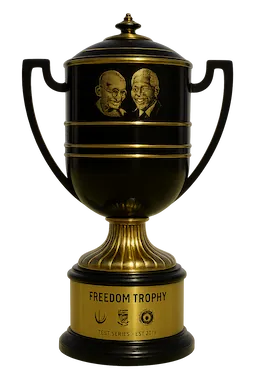
Freedom Trophy
Freedom Trophy (also known as the Gandhi-Mandela Trophy) is a prestigious Test cricket series contested between India and South Africa, created to honor the shared values of Mahatma Gandhi and Nelson Mandela and to celebrate the nations’ historic ties through the game. It was first introduced in 2015 as part of the bilateral Test contests between the two cricketing giants, symbolizing mutual respect, resilience, and freedom. Over the years, five editions have been played, each producing gripping battles across challenging conditions, from the pace-friendly tracks of Centurion to the turning pitches of Chennai.
The 2025 edition, played in India from 14th-26th November, saw South Africa claim a commanding 2-0 Test series win, securing the Freedom Trophy and vital ICC World Test Championship points. While India responded with victories in the ODI (2-1) and T20I (3-1) legs of the tour, the Proteas remain the current holders of the prestigious Test prize.
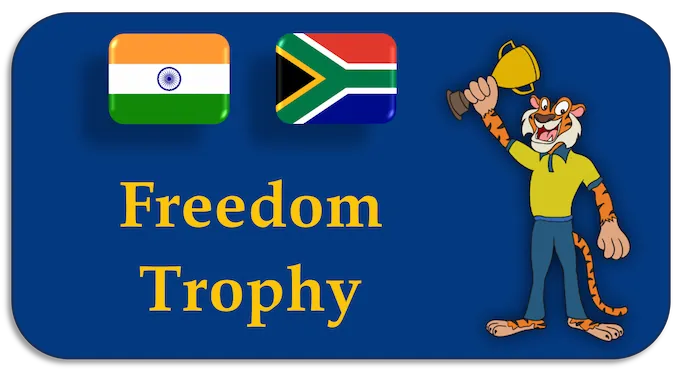










Introduction
The winner of the Test series between South Africa and India receives the Freedom Trophy, a cricket trophy dedicated to Nelson Mandela and Mahatma Gandhi. The trophy was introduced in 2015, when the BCCI and CSA announced that future Test series between the two countries would be played for the Freedom Trophy. Before the trophy was established, India and South Africa had played eleven Test series, with six taking place in South Africa and five in India. South Africa won six of those series, India won two, and three ended in draws.
The upcoming bilateral visits between South Africa and India would be referred to as the Mahatma Gandhi-Nelson Mandela Bilateral Series, the BCCI and CSA decided in 2015. A Test cricket format is used for the series. The series is named after the founding figures of both nations in recognition of their contributions to the struggle for freedom and equality. The name reflects the shared historical connections between the two countries and has helped give the series a distinctive identity in international cricket.
The "Freedom Trophy" was established for the Test series. The trophy commemorates the ideals associated with Nelson Mandela and Mahatma Gandhi and their roles in the struggles for freedom and social change. By naming the series after these influential leaders, the BCCI and CSA created a lasting tribute that connects the cricket rivalry with the historical relationship between India and South Africa.
To further enhance your understanding of the Freedom Trophy, you can also read this article in Hindi (फ्रीडम ट्रॉफी हिंदी समीक्षा). As a part of IndiaBetMaster.com, this article provides useful background on the series, including its history, structure and key context. Dive into the details in English or Hindi to get a broader picture of this long-running Test rivalry.
Best Online Betting Sites in India - October 2026









































Current Season
A fresh chapter unfolded when South Africa toured India from November 14 to December 19, 2025, for a full multi-format series that included the Freedom Trophy Test contests. The itinerary featured two Tests (Nov 14-18 at Eden Gardens, Kolkata, and Nov 22-26 at Barsapara, Guwahati), followed by three ODIs (Nov 30 in Ranchi, Dec 3 in Raipur, Dec 6 in Visakhapatnam), and a five-match T20I leg across Cuttack, New Chandigarh, Dharamsala, Lucknow, and Ahmedabad. The Test series formed part of the 2025-2027 ICC World Test Championship cycle. The Freedom Trophy applied to the Test series, while the broader tour covered all three international formats between India and South Africa.
Guwahati hosted its first-ever Test during the tour, marking a new venue for Test cricket in India. The BCCI had initially scheduled the first Test in New Delhi before announcing in June 2025 that it would be shifted to Eden Gardens in Kolkata. The updated schedule retained the second Test in Guwahati from November 22-26, followed by the three-match ODI series in Ranchi, Raipur, and Visakhapatnam and the five-match T20I series from December 9 to 19. The tour did not include additional international tour matches between the scheduled fixtures.
The Freedom Trophy was decided emphatically. South Africa won the series 2-0, defeating India by 30 runs in Kolkata and by 408 runs in Guwahati. The result gave South Africa a second Test series win in India and added valuable points to their 2025-2027 ICC World Test Championship campaign. India responded in the white-ball formats, winning the ODI series 2-1 and the T20I series 3-1. The five-match T20I series began with an India win in Cuttack, South Africa levelled the series in New Chandigarh, and India then won the remaining three matches in Dharamsala, Lucknow, and Ahmedabad.
The tour also provided a substantial block of international cricket across Test, ODI, and T20I formats. The two Tests carried World Test Championship significance, while the ODI and T20I series added further competitive context to the multi-format contest. The T20I leg also served as preparation ahead of the ICC Men’s T20 World Cup 2026, with the series running from December 9 to December 19. Across the tour, the schedule moved through ten matches and nine venues, taking the teams from Kolkata and Guwahati into a December white-ball programme across eastern, northern, western, and southern parts of India.
The tour featured a wide spread of major Indian cricket venues. The first ODI was played at the JSCA International Stadium Complex in Ranchi, followed by the second ODI at Shaheed Veer Narayan Singh International Cricket Stadium in Raipur and the third at Visakhapatnam. The T20I series then moved through Cuttack, New Chandigarh, Dharamsala, Lucknow, and Ahmedabad, with the Narendra Modi Stadium hosting the final match. The two Tests were staged at Eden Gardens and the Barsapara Cricket Stadium, with Guwahati making its debut as a Test venue during the series.
The tour added another significant chapter to the India-South Africa Test rivalry, with the Freedom Trophy continuing to carry the names and legacy associated with Mahatma Gandhi and Nelson Mandela. The trophy is awarded to the winner of the Test series between the two countries, while the teams can also meet across ODI and T20I cricket during broader multi-format tours. The 2025 series therefore combined the historic symbolism of the Freedom Trophy with a wider international programme across all three formats.
Looking ahead, the Freedom Trophy remains part of the wider India-South Africa Test rivalry and the ICC World Test Championship framework. The 2025 series was played within the 2025-2027 WTC cycle, but specific details for a subsequent Freedom Trophy series in 2027 should not be stated as confirmed until the relevant fixtures and venues are officially announced. For now, the confirmed 2025 edition provides the latest completed chapter in the Test contest, alongside the accompanying ODI and T20I series.
Ongoing October 2026 Events
 |
ICC World Test Championship (WTC) Test | June 17, 2025 – June 13, 2027 | LIVE |
|
ICC Women's Championship ODI | February 20, 2026 – April 15, 2029 | LIVE |
 |
Minor League Cricket (MiLC) T20 | September 17, 2026 – October 25, 2026 | LIVE |
|
Cricket at the Asian Games T20I | September 17, 2026 – October 3, 2026 | |
  |
South Africa vs Australia Tour | September 24, 2026 – October 31, 2026 | LIVE |
 |
Col CK Nayudu Winners vs ROI FC | October 1–4, 2026 | |
|
Irani Cup FC | October 1–5, 2026 | |
 |
National Cricket League (NCL) FC | October 3, 2026 – November 17, 2026 | LIVE |
|
Vinoo Mankad Trophy List A | October 8–27, 2026 | LIVE |
  |
Sri Lanka vs Pakistan Tour | October 9, 2026 – November 21, 2026 | LIVE |
|
Women's U19 T20 Trophy T20 | October 9–26, 2026 | LIVE |
|
Ranji Trophy FC | October 11, 2026 – March 3, 2027 | LIVE |
|
Col CK Nayudu Trophy Multi-Day | October 12, 2026 – March 1, 2027 | LIVE |
 |
India vs New Zealand Tour | October 22, 2026 – December 1, 2026 | |
 |
Nepal Premier League (NPL) T20 | October 26, 2026 – November 21, 2026 | |
|
Senior Women's T20 Trophy T20 | October 26, 2026 – November 20, 2026 | |
 |
Bangladesh vs West Indies Test | October 28, 2026 – November 9, 2026 | |
|
Women's Big Bash League (WBBL) T20 | October 29, 2026 – December 5, 2026 | |
|
Women's U19 T20 Challenger Trophy T20 | October 30, 2026 – November 5, 2026 |
Ongoing October 2026 Events
|
ICC World Test Championship (WTC) Test | June 17, 2025 – June 13, 2027 | LIVE |
|
ICC Women's Championship ODI | February 20, 2026 – April 15, 2029 | LIVE |
|
Minor League Cricket (MiLC) T20 | September 17, 2026 – October 25, 2026 | LIVE |
|
Cricket at the Asian Games T20I | September 17, 2026 – October 3, 2026 | |
|
South Africa vs Australia Tour | September 24, 2026 – October 31, 2026 | LIVE |
|
Col CK Nayudu Winners vs ROI FC | October 1–4, 2026 | |
|
Irani Cup FC | October 1–5, 2026 | |
|
National Cricket League (NCL) FC | October 3, 2026 – November 17, 2026 | LIVE |
|
Vinoo Mankad Trophy List A | October 8–27, 2026 | LIVE |
|
Sri Lanka vs Pakistan Tour | October 9, 2026 – November 21, 2026 | LIVE |
|
Women's U19 T20 Trophy T20 | October 9–26, 2026 | LIVE |
|
Ranji Trophy FC | October 11, 2026 – March 3, 2027 | LIVE |
|
Col CK Nayudu Trophy Multi-Day | October 12, 2026 – March 1, 2027 | LIVE |
|
India vs New Zealand Tour | October 22, 2026 – December 1, 2026 | |
|
Nepal Premier League (NPL) T20 | October 26, 2026 – November 21, 2026 | |
|
Senior Women's T20 Trophy T20 | October 26, 2026 – November 20, 2026 | |
|
Bangladesh vs West Indies Test | October 28, 2026 – November 9, 2026 | |
|
Women's Big Bash League (WBBL) T20 | October 29, 2026 – December 5, 2026 | |
|
Women's U19 T20 Challenger Trophy T20 | October 30, 2026 – November 5, 2026 |



Previous Seasons
The Freedom Trophy stands as the defining symbol of Test cricket rivalry between India and South Africa, celebrating excellence, resilience, and the spirit of long-format cricket. Introduced in 2015-2016 to honour Mahatma Gandhi and Nelson Mandela, the trophy quickly became one of the most respected bilateral honours in the Test arena. Across its editions, the contest has produced memorable spells of fast bowling, decisive batting performances, and several momentum-shifting sessions that shaped series outcomes. India have traditionally dominated at home while South Africa have excelled in their own conditions, creating a balanced historical narrative with competitive swings. Over time, the Freedom Trophy has grown into a marquee fixture for fans who follow Test cricket closely, often influencing team cycles, selection debates, and long-term planning for both boards.
Past Freedom Trophy Editions
- 2025-2026 Series (India)
The 2025-2026 Freedom Trophy featured a compact two-Test series played in Kolkata and Guwahati, with Guwahati hosting a Test for the first time. South Africa delivered a commanding performance throughout the series, sweeping the contest 2-0 and securing their first Test series win in India since 2000. The opening Test at Eden Gardens unfolded on a challenging surface with uneven bounce, where South Africa edged ahead by 30 runs, driven by Simon Harmer’s decisive off-spin spells. The second Test in Guwahati saw a dominant all-round display from Marco Jansen, culminating in a massive 408-run victory that sealed the trophy. The series ran from 14 November to 26 November 2025, with Temba Bavuma’s leadership and South Africa’s disciplined approach proving central to their success.
Beyond the cricketing storyline, the series carried notable significance. India navigated a captaincy change after Shubman Gill suffered a neck injury, with Rishabh Pant leading the side in Guwahati, while South Africa showcased depth in their spin resources, historically not their strongest suit. The tour also included limited-overs fixtures, but the Test leg remained the focal point as South Africa claimed the Freedom Trophy with clinical precision. Their triumph added a fresh chapter to the rivalry, reinforcing the competitive balance that has defined the contest since its inception.
- 2023-2024 Series (South Africa)
The 2023-2024 Freedom Trophy was played as a two-Test series in South Africa from 26 December 2023 to 3 January 2024, forming part of the 2023-2025 ICC World Test Championship. The contest ended 1-1, reflecting a tightly balanced battle across contrasting conditions. South Africa dominated the opening Test at Centurion, winning by an innings and 32 runs on a lively surface where Dean Elgar signed off from Test cricket with a commanding 201-run series tally. India responded strongly in the second Test at Cape Town, chasing 79 to secure a seven-wicket victory after Jasprit Bumrah’s incisive spells shaped the match.
The series carried additional significance as both sides were transitioning key roles. South Africa navigated the absence of Temba Bavuma after he was injured on the opening day of the first Test, while India managed squad changes during the tour. Despite the short format, the series produced high-intensity cricket, reaffirming the rivalry’s reputation for producing decisive sessions and dramatic momentum shifts.
- 2021-2022 Series (South Africa)
The 2021-2022 Freedom Trophy was a three-Test series held in South Africa from 26 December 2021 to 14 January 2022, ultimately won 2-1 by South Africa. India started strongly with a historic victory at Centurion, their first-ever Test win at the venue. However, South Africa staged a remarkable comeback, winning in Johannesburg and Cape Town, both by seven wickets, driven by Keegan Petersen’s breakout series and Kagiso Rabada’s incisive spells.
The series was notable for several major developments. Quinton de Kock retired from Test cricket after the first match, and Virat Kohli stepped down as India’s Test captain immediately after the series. Played during pandemic-era restrictions, the contest still delivered high-quality cricket, with South Africa’s young core rising to the occasion and India’s pace attack continuing to impress despite the final result.
- Earlier Test Series
Since its inception in 2015-2016, the Freedom Trophy has consistently produced high-stakes Test cricket between India and South Africa. India have dominated the trophy on home soil, leveraging spin depth and batting stability, while South Africa have relied on pace strength and home familiarity to secure wins in their conditions. Across the early cycles, standout performers such as Virat Kohli, Hashim Amla, Ravichandran Ashwin, Kagiso Rabada, and Dean Elgar shaped defining moments, contributing to several series that swung on single sessions of high-pressure cricket.
The earliest editions established clear patterns: India’s commanding home victories in 2015-2016 and 2019-2020 set the tone for their dominance in subcontinental conditions, while South Africa’s resilience in 2017-2018 and again in 2021-2022 reinforced their ability to counter India’s strengths with disciplined seam bowling and gritty batting. These foundational years also saw the rivalry gain cultural significance, with the trophy honouring Gandhi and Mandela, adding symbolic weight to an already competitive cricketing relationship.
Over time, the Freedom Trophy has become a fixture that influences team planning, selection debates, and long-term Test strategies. The contest’s history is marked by decisive spells from fast bowlers, tactical captaincy battles, and several series that impacted ICC World Test Championship standings. As the rivalry continues, each edition adds fresh narratives to a competition that remains one of the most compelling bilateral Test engagements in modern cricket.
| Season | Champion | Runner-up | Final Result | Event / Final Location |
|---|---|---|---|---|
| Gandhi-Mandela Trophy (Freedom Trophy) | ||||
| 2025-2026 | South Africa | India | South Africa won 2-0 (2 Tests) | India |
| 2023-2024 | -- | -- | Series drawn 1-1 (2 Tests) | South Africa |
| 2021-2022 | South Africa | India | South Africa won 2-1 (3 Tests) | South Africa |
| 2019-2020 | India | South Africa | India won 3-0 (3 Tests) | India |
| 2017-2018 | South Africa | India | South Africa won 2-1 (3 Tests) | South Africa |
| 2015-2016 | India | South Africa | India won 3-0 (4 Tests) | India |
| Test Series | ||||
| 2013-2014 | South Africa | India | South Africa won 1-0 (2 Tests) | South Africa |
| 2010-2011 | -- | -- | Series drawn 1-1 (3 Tests) | South Africa |
| 2009-2010 | -- | -- | Series drawn 1-1 (2 Tests) | India |
| 2007-2008 | -- | -- | Series drawn 1-1 (3 Tests) | India |
| 2006-2007 | South Africa | India | South Africa won 2-1 (3 Tests) | South Africa |
| 2004-2005 | India | South Africa | India won 1-0 (2 Tests) | India |
| 2001-2002 | South Africa | India | South Africa won 1-0 (2 Tests) | South Africa |
| 1999-2000 | South Africa | India | South Africa won 2-0 (2 Tests) | India |
| 1996-1997 | India | South Africa | India won 2-1 (3 Tests) | India |
| 1996-1997 | South Africa | India | South Africa won 2-0 (3 Tests) | South Africa |
| 1992-1993 | South Africa | India | South Africa won 1-0 (4 Tests) | South Africa |
* Refers only to Test cricket encounters
History and Structure
Both India and South Africa played eleven series before the trophy was established, six in South Africa and five in India. Six South African triumphs, two Indian victories, and three series that ended in draws made up the overall record. The upcoming series between India and South Africa would be known as "The Mahatma Gandhi-Nelson Mandela Series," the two nations had declared.
The "Freedom Trophy," which has been contested in recent Test series between the two countries, was also launched by the Board of Control for Cricket in India and Cricket South Africa. It is named in honor of the two political personalities. Gandhi and Mandela were two of the most influential historical figures associated with the political transformation of their respective nations.
The Freedom Trophy, contested between India and South Africa, was first introduced in 2015 as a symbol of the shared legacy of Mahatma Gandhi and Nelson Mandela. The bilateral Test series has been shaped by the wider cricket calendar and the scheduling demands of tours between the two countries. The Board of Control for Cricket in India (BCCI) and Cricket South Africa (CSA) organize the series as part of the international cricket calendar.
One of the major milestones in the structure of the Freedom Trophy was its inception in 2015. The inaugural Freedom Trophy series saw India host South Africa in a multi-format tour featuring Tests, ODIs, and T20Is, with the four-Test series forming the trophy contest. The Tests were played in Mohali, Bengaluru, Nagpur, and Delhi, with India winning the series 3-0. The series established the Freedom Trophy as a named bilateral contest between the two sides.
Over the years, the scheduling of the Freedom Trophy has been influenced by the international cricket calendar and the broader demands of bilateral tours. Changes in broadcasting and digital media have also expanded how India-South Africa Test cricket is presented to audiences, with live coverage, pre-match analysis, and digital content becoming an increasingly important part of the viewing experience.
Furthermore, the structure of India-South Africa cricket has been affected by global events such as the COVID-19 pandemic, which led to adjustments to international tour schedules and the use of bio-secure arrangements. The period also accelerated changes in digital cricket coverage and fan engagement. The Freedom Trophy's history therefore reflects both the sporting rivalry between India and South Africa and the changing environment surrounding international Test cricket.


Final Thoughts
The Freedom Trophy has grown into one of the most meaningful bilateral contests in Test cricket, shaped by the shared history and values that connect India and South Africa. Across its editions, the competition has consistently delivered high-quality cricket marked by tactical depth, standout individual performances, and conditions that test every facet of the game. From pace-dominated battles in South Africa to spin-led contests in India, the trophy has showcased how both teams adapt and evolve while preserving the traditional strengths that define their cricketing identities.
Over the years, the rivalry has produced several defining moments that continue to influence how fans and analysts view the long-format game. India’s development into a formidable travelling Test side, South Africa’s ability to rebuild through new talent cycles, and the emergence of match-winning spells from both pace and spin have all contributed to the trophy’s stature. The contest has also reflected changes in leadership, selection philosophies, and broader strategic planning for both boards, reinforcing its importance beyond the immediate results on the field.
As the Freedom Trophy continues to unfold across future cycles, it remains a fixture that celebrates resilience, skill, and the enduring appeal of Test cricket. Its legacy is built on competitive contests, cultural significance, and the spirit of two cricketing nations that consistently push each other to higher standards. With every series adding fresh narratives and memorable performances, the trophy stands as a reminder of why this rivalry holds a special place in the modern Test landscape.
Did You Know
